American concert fans still place enormous value on live events. The process of getting through the door, however, appears to be testing their trust.
New research conducted by Kantar for ticket resale marketplace Tixel found that U.S. consumers reported higher levels of ticket fraud, inflated resale pricing and checkout friction than respondents in the U.K. and Australia.
The findings come from Tixel's Future of Ticketing Report: The Live Equation 2030, based on a Kantar survey of 5,107 consumers across the United States, United Kingdom and Australia. The sample included 1,522 U.S. respondents who had purchased a ticket, attended a ticketed live event or wanted to attend one during the previous 12 months.
U.S. Fans Report More Ticket Fraud and Inflated Resale Prices
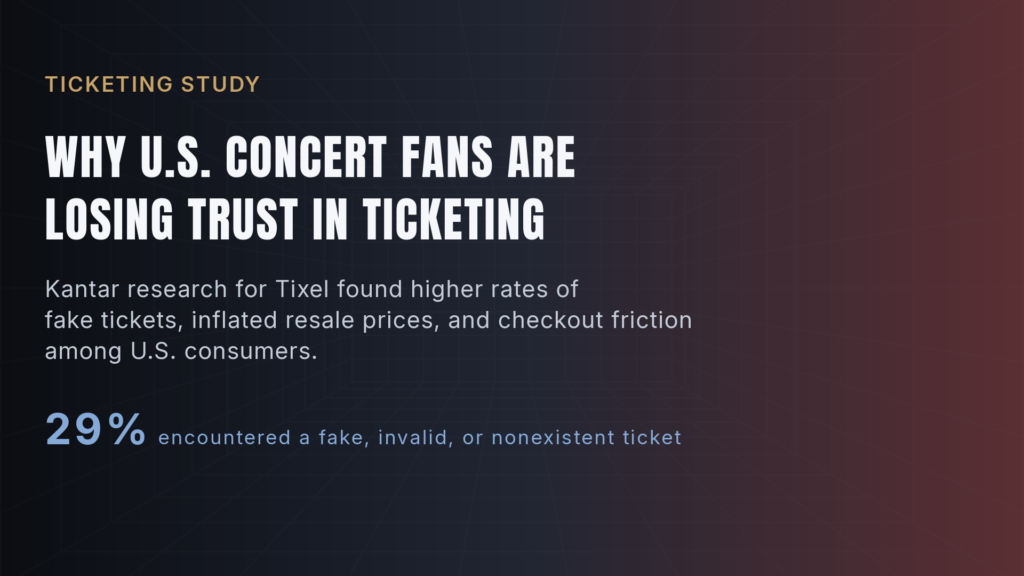
Among U.S. respondents, 29% said they had encountered a fake, invalid or nonexistent ticket during the previous year. The finding points to a significant trust problem at a particularly sensitive point in the live-event economy: the moment when a fan commits money to attending a show.
Resale pricing presents another challenge. 56% of U.S. respondents said they had paid a resale price they considered significantly inflated, the highest percentage among the three countries studied.
According to an analysis published by EDM.com, two-thirds of American respondents had previously purchased a resale ticket, while 75% believed bots or brokers were acquiring tickets and reselling them at inflated prices.
Checkout Fees Are Driving Purchase Abandonment
The problem is not limited to the secondary market.
The research found that 28% of U.S. respondents had abandoned a ticket purchase because of processing fees or unexpected charges at checkout. That compares with 20% of respondents in both the U.K. and Australia.
For promoters, venues and ticketing companies, that number is especially important because the customer has already progressed deep into the purchase process. The fan has discovered the event, evaluated the artist and price, selected a ticket and reached checkout — only to walk away when the final cost changes.
That makes fee transparency more than a customer-service issue. It can directly affect conversion.
Fans May Pay More for Certainty
One of the more interesting findings is that consumers do not appear to be focused exclusively on obtaining the lowest possible ticket price.
Among U.S. respondents, 78% said they would rather pay more for a verified or guaranteed ticket than save money on one they considered uncertain.
Another 67% said knowing they could resell a ticket if their plans changed made them more comfortable purchasing it in the first place.
That suggests flexibility itself has value. A ticket that can be securely transferred or resold may reduce the perceived risk of committing early, particularly when a concert is months away.
The broader report summary from the Association of Artist Managers, describes this as a growing demand for certainty: consumers want confidence that tickets are legitimate, prices are understandable and their purchase will retain some flexibility if circumstances change.
The Ticket Price Is No Longer the Entire Value Equation
The research also points to a broader shift in how consumers evaluate live events.
Fans increasingly appear to be judging the value of the entire night rather than the ticket in isolation. That calculation can include the ticket price, fees, transportation, food and drinks, production quality, atmosphere, time commitment and the confidence that the experience will ultimately justify the total expense.
Tixel's report describes five forces shaping this behavior: social participation, elevated experiences, emotional value, purchase certainty and changing trust in an increasingly algorithm-driven environment.
That matters because a lower face-value ticket does not necessarily create a strong value proposition if the customer later encounters large fees, uncertain resale options or poor confidence in the purchase itself.
Trust Can Affect Early Ticket Sales
For independent promoters in particular, the findings reinforce the importance of reducing uncertainty during the early stages of an onsale.
Early ticket buyers accept more uncertainty than customers purchasing immediately before an event. They are committing money further in advance, often before they know exactly what their schedule will look like months later.
Transparent pricing, credible ticketing partners, straightforward refund and transfer policies, and reasonable resale options can therefore influence more than customer satisfaction. They may also help remove reasons for a prospective buyer to delay making a decision.
That relationship between confidence and early commitment is especially important because initial sales velocity can shape how an event develops. Strong early demand provides promoters with useful information about pricing, advertising and audience response while also creating visible momentum around the event.
A Commercial Report With Useful Data
There is an important qualification to the research.
Tixel operates a ticket resale marketplace, meaning several of the report's recommendations — particularly those supporting verified resale and greater resale flexibility — align with the company's commercial interests.
That does not invalidate the survey results, but the distinction matters when interpreting the report's policy conclusions. The underlying consumer research was conducted by Kantar, while Tixel commissioned the study and provides the broader industry interpretation.
An analysis by the Australian Live Music Business Council similarly notes Tixel's commercial interest while describing the three-country comparison as one of the report's most useful elements.
The Bigger Problem Is Friction
The report does not suggest that Americans have lost interest in concerts. If anything, the opposite appears true.
The problem is the amount of uncertainty and friction standing between interest and attendance.
When fans encounter fraudulent tickets, dramatically marked-up resale inventory or unexpected fees at checkout, the experience can erode confidence not only in a particular transaction but in the broader ticket-buying process.
For the live-events industry, that creates a relatively straightforward challenge: make it easier for fans to understand what they are paying, know that their ticket is legitimate and feel comfortable committing to the purchase.
The artist may still be what makes someone want to attend. Increasingly, however, the quality and transparency of everything surrounding that ticket may determine whether they actually buy it.