Congress Passes American Music Tourism Act, Sending Bill to President
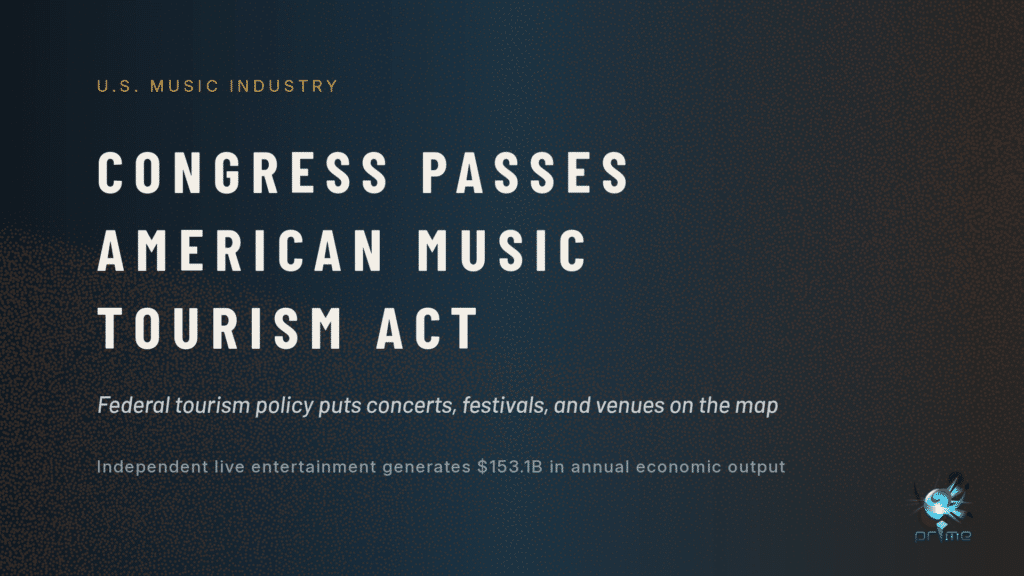
Congress has passed the American Music Tourism Act, sending legislation to the President that would formally make music tourism part of the federal government’s strategy for promoting travel within the United States.
The U.S. House of Representatives passed S. 195 by voice vote on September 15, 2026, following Senate passage by unanimous consent in May 2025. The enrolled version of the bill was published by the U.S. Government Publishing Office on September 18.
What the American Music Tourism Act Does
The legislation amends the Visit America Act and directs the Assistant Secretary of Commerce for Travel and Tourism to identify locations and events that are important to music tourism and promote domestic travel to them.
NIVA notes that the legislation’s definition of music tourism reaches beyond major arenas and destination festivals, encompassing travel to concerts and live performances as well as venues of all sizes, museums, studios, historic sites and other music-related destinations.
It also places music alongside other established drivers of U.S. tourism by incorporating music-related destinations into efforts aimed at international travelers.
Why It Matters to the Live Music Business
For the live entertainment industry, the significance is not simply that the federal government is promoting concerts. The legislation formally recognizes live music as part of the country’s tourism economy.
A concert can create spending well beyond the ticket itself. Fans traveling for an event may also spend money on hotels, restaurants, transportation, retail and other businesses surrounding a venue or festival site.
That economic effect is particularly important for independent operators.
According to the National Independent Venue Association, independent venues, festivals and promoters generate approximately $153 billion in annual economic output, contribute approximately $86 billion directly to U.S. GDP and support more than 907,000 jobs.
NIVA estimates that independent stages are also responsible for more than $10.6 billion in annual visitor spending on lodging, dining, shopping and local transportation.
Independent Venues and Promoters Are Included
One of the more notable elements of the legislation is its explicit inclusion of music destinations at different scales.
The federal tourism strategy is not limited to stadium tours or nationally recognized festivals. Smaller concert venues, independent festivals and other live-music destinations can also fall within the definition of music tourism.
For independent promoters, that distinction matters. A smaller independent event may be modest relative to an arena show, but it can still attract visitors from outside the immediate market and generate spending across hotels, restaurants, transportation and surrounding businesses.
The Act therefore reflects an economic reality that has long existed in live entertainment: the impact of a show extends beyond the venue doors.
Music Tourism Becomes a Federal Tourism Priority
The American Music Tourism Act does not create a new concert subsidy program or directly fund promoters and venues. Instead, it changes how the federal tourism apparatus identifies and promotes music-related destinations.
That distinction is important. The legislation is primarily about tourism promotion and recognition, rather than direct financial assistance to the live-events industry.
If signed into law, implementation would fall to the Department of Commerce through its travel and tourism responsibilities. NIVA has said it intends to work with the Department of Commerce on implementation once the legislation becomes law.
The development has also begun receiving attention within electronic music media. EDM.com reported on the bill on September 21, emphasizing its implications for festivals, venues and other music destinations.
A Broader View of the Concert Economy
For promoters, venues and festival producers, the legislation puts a federal policy framework around something the live-music business already understands: people routinely travel because of music.
Whether the destination is a major festival, a historic club, an independent theater or a one-night electronic music event, the ticket purchase is often only one component of the visitor’s total economic activity.
That broader economic reach is also visible in record-setting international touring, where major electronic artists are increasingly drawing large audiences across multiple markets.
The American Music Tourism Act gives that relationship between live music and travel explicit recognition in federal tourism policy.
With both chambers having approved S. 195, the bill was enrolled on September 18 and sent to the President for consideration.